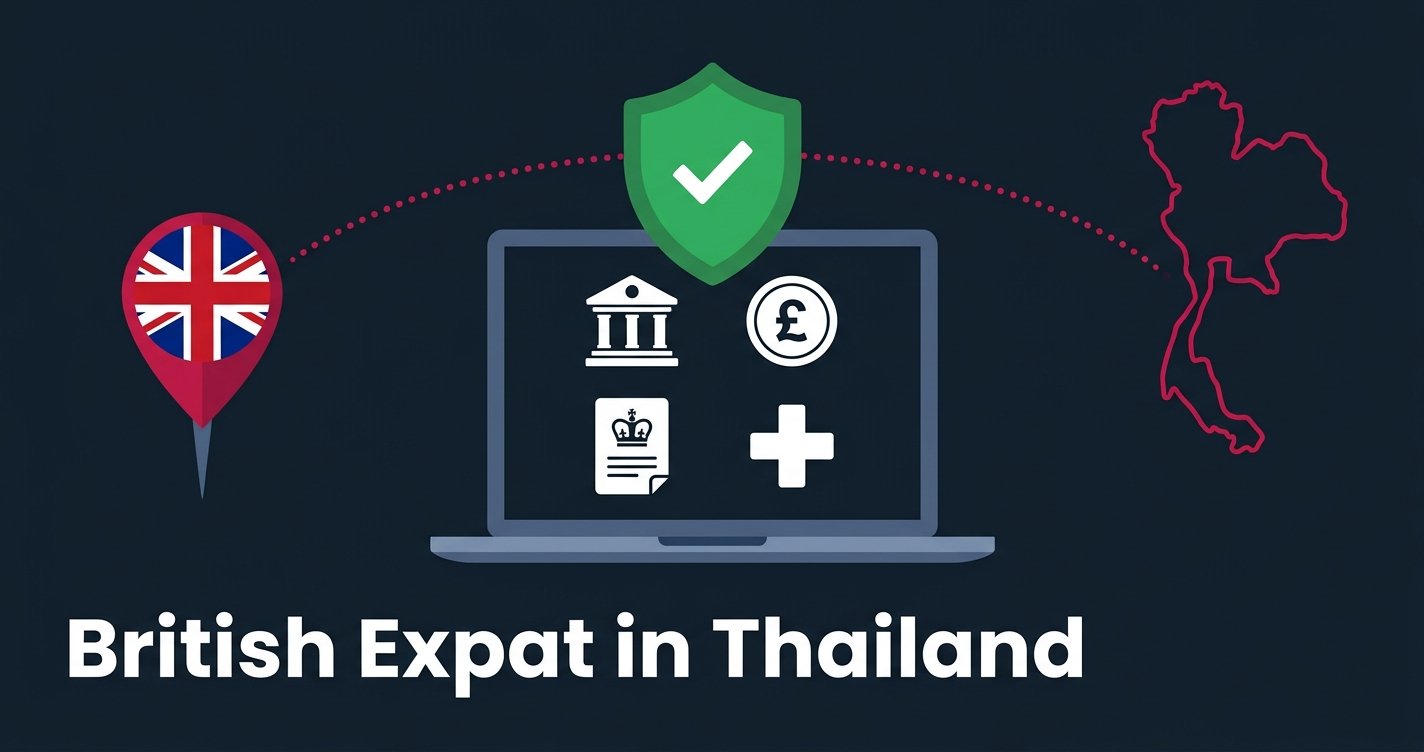
British Expat in Thailand VPN Guide: Banking, HMRC and UK Services (2026)
Moving to Thailand is easy compared with keeping your UK life running from 9,500 kilometres away. For a British expat in Thailand, the problems rarely come from Thailand itself. They come from UK banks, HMRC, and government portals that treat a Thai login as suspicious or simply block it.
This guide covers everything a British expat in Thailand needs to keep working from Pattaya, Hua Hin, Bangkok, Phuket, or Chiang Mai: UK banking apps, HMRC and GOV.UK One Login, the State Pension, the NHS App, and security on Thai WiFi.
If you are mainly here for UK television, our dedicated guide to BBC iPlayer in Thailand covers iPlayer, ITVX, and Channel 4 step by step.
Why a British Expat in Thailand Needs a VPN
UK banks and government services check where each login comes from. A Thai IP address from AIS, True, or 3BB is an unusual location for a UK account, so it can trigger extra security checks, temporary blocks, or outright refusals.
A VPN connected to a UK server gives you a UK IP address, so your logins look the same as they did at home. It also encrypts your connection, which matters in a country where most daily browsing happens on shared condo, hotel, and cafe WiFi.
For a British expat in Thailand, a VPN is not about getting around Thai rules. VPN use is legal in Thailand, as our guide on whether a VPN is legal in Thailand explains, and the main job is keeping UK services working.
🏆 Best VPN for British Expats in Thailand
NordVPN keeps your UK bank, HMRC, NHS and BBC iPlayer working from Thailand with 440+ UK servers. 30-day money-back guarantee.
UK Banking From Thailand
Banking is the most common problem. Barclays, Lloyds, HSBC, NatWest, Monzo, and Starling all run fraud checks that look at login location, and a sudden switch to Thailand can freeze card payments or lock the app.
Connecting to a UK server before opening your banking app usually solves this. Our step-by-step fixes for the Barclays app, Lloyds app, Monzo, and Starling cover the details for each bank.
If your bank still keeps asking for verification, a dedicated IP address helps. It gives you the same UK address every time, which builds a trusted login history, as our dedicated IP for banking guide explains.
Keep a UK Phone Number for Security Codes
Many UK banks and government services still send one-time codes by SMS. If you cancel your UK phone contract when you move, you can lock yourself out of your own accounts.
Most British expats in Thailand keep a cheap UK pay-as-you-go SIM or eSIM for this reason and use a Thai SIM for daily data. Check that your UK SIM has roaming enabled so codes arrive while you are in Thailand.
Where your bank offers app-based approval instead of SMS, switch to it before you leave the UK. It is faster and does not depend on roaming.
HMRC, GOV.UK One Login, and Tax
Many British expats in Thailand still have UK income from rent, pensions, or investments, and need to file a Self Assessment return. HMRC online services and GOV.UK One Login can ask for extra verification or fail to load from Thai connections.
A UK server makes the login process far more reliable. Our guides to HMRC Self Assessment abroad and GOV.UK One Login abroad cover the most common errors.
Tax residence is a separate question from VPN access. If you spend most of the year in Thailand, take professional advice on where you are tax resident, because a VPN changes your IP address but not your legal residence.
The UK State Pension in Thailand
You can receive your UK State Pension in Thailand, paid into a UK or Thai bank account. However, Thailand is one of the countries where the State Pension is frozen, so it does not rise each year as it would in the UK.
The GOV.UK guidance on retiring abroad explains the rules. Managing your pension online through the DWP is easier from a UK connection, as our State Pension portal guide explains.
Private pensions, ISAs, and Premium Bonds usually carry on as normal, although some providers restrict new investments for non-residents. Our guides to managing an ISA abroad and NS&I Premium Bonds abroad cover the access side.
NHS, DVLA, and Passport Services
NHS App. NHS care is based on living in the UK, so it does not cover you in Thailand. The NHS App can still be useful for records and prescriptions when you visit home, and our NHS App abroad guide explains access problems.
Driving licence. The DVLA generally needs a UK address to renew a UK licence. Our guide to renewing a UK driving licence abroad explains the options, and most long-term residents also get a Thai licence.
Passport. You can renew a British passport online from Thailand, and a UK connection makes the portal more reliable. Our UK passport renewal abroad guide covers the process.
Health Insurance for a British Expat in Thailand
Because NHS care depends on living in the UK, a British expat in Thailand needs private cover for treatment locally. Thai private hospitals in Bangkok, Pattaya, and Phuket are excellent, but they are expensive without insurance.
Some Thai long-stay and retirement visas also require proof of health insurance, so check the current rules for your visa type before you apply. Our guide to travel insurance for long-term expats explains the difference between travel medical cover and full international health insurance.
Insurer portals from Bupa, AXA, and Cigna can also flag foreign logins, as our health insurance portal guide explains.
Moving Money From the UK to Thailand
High street bank transfers from pounds to Thai baht are expensive, with poor exchange rates and fees at both ends. Many British expats in Thailand use Wise instead, which converts at the real exchange rate with a small upfront fee.
This matters for retirees in particular, because Thai retirement visas require proof of funds or monthly income. Moving that money cheaply saves real money every year, as our Wise for expats guide explains.
Wise accounts can also flag unusual logins. If yours does, a UK server usually helps, as our guide to a Wise account blocked abroad shows.
🔒 Proton VPN: Private Banking on Thai WiFi
Swiss no-logs protection for your UK accounts on hotel and condo WiFi, with UK servers and a flexible monthly plan. 30-day money-back guarantee.
Staying Safe on Thai WiFi
Free WiFi is everywhere in Thailand, from condo lobbies to shopping malls and airport lounges. Much of it is unencrypted or shared by hundreds of people.
A British expat in Thailand logging into UK banking or HMRC on that WiFi should always have a VPN switched on. Turn on auto-connect so the VPN starts automatically on any network you do not trust.
Our public WiFi safety tips cover the full checklist, including how to spot fake hotspots.
How to Set Up a VPN as a British Expat in Thailand
Step 1: Choose a provider with strong UK servers. Visit the NordVPN website and pick a plan, ideally before you fly so everything is ready on arrival.
Step 2: Install it on every device. Put the app on your phone, laptop, tablet, and Fire TV Stick. One NordVPN account covers up to ten devices.
Step 3: Use a UK server for UK services. Connect to London for banking, HMRC, and GOV.UK. Use split tunnelling so Thai apps such as Grab and your Thai bank app stay on your normal connection.
Step 4: Turn on auto-connect. This protects you automatically on hotel and cafe WiFi.
The Best VPN for a British Expat in Thailand
You need three things: reliable UK servers that banks and the BBC accept, good speed over the long route to Europe, and apps for every device. Thailand does not block VPNs, so there is no need for special obfuscation features.
NordVPN is our first choice. It has a large UK server network, the fast NordLynx protocol, an optional dedicated UK IP for banking, and a 30-day money-back guarantee.
Proton VPN is the best alternative for privacy. It is Swiss-based with an audited no-logs policy and suits anyone who prefers to pay monthly, and you can try it here. For a full comparison, see our guides to the best VPN for UK expats and the best VPN for expats in Thailand.
Checklist for a British Expat in Thailand Before You Fly
- Keep a UK phone number for bank and HMRC security codes, with roaming enabled.
- Install and test a VPN with UK servers on every device before you leave.
- Tell your bank you are moving, and switch to app-based approvals where possible.
- Set up GOV.UK One Login and HMRC access while you still have a UK address and phone.
- Open a Wise account for cheaper transfers from pounds to Thai baht.
- Arrange private health insurance that covers treatment in Thailand.
Doing these six things in the UK saves hours of frustration later. For a British expat in Thailand, the phone number and banking setup cause the most trouble when they are missed.
Useful Official Resources
The UK Government’s living in Thailand guidance covers healthcare, visas, pensions, and registering with the embassy. It is the best starting point for any British expat in Thailand.
The FCDO travel advice for Thailand covers local laws, safety, and entry rules, and it is updated regularly.
If you are planning a long-term move, our retiring to Thailand VPN guide brings the digital side together in one checklist.
🎯 Choose Your VPN for Thailand
All VPNs offer 30-day money-back guarantees
Frequently Asked Questions: British Expat in Thailand
Do British expats in Thailand need a VPN?
It is not required, but it solves the most common problems. UK banks, HMRC, and GOV.UK often flag Thai logins, and UK streaming services block Thai IP addresses. A UK server fixes both and encrypts your connection on public WiFi.
Why does my UK banking app not work in Thailand?
Banks treat a sudden login from Thailand as a possible fraud signal. Connect to a UK VPN server before opening the app, keep your UK phone number active for security codes, and consider a dedicated UK IP address.
Is my UK State Pension frozen in Thailand?
Yes. Thailand is one of the countries where the UK State Pension is paid but not increased each year. GOV.UK explains the rules for retiring abroad.
Is a VPN legal in Thailand?
Yes. VPN use is legal in Thailand. The country’s strict laws concern content such as comments about the monarchy, gambling, and piracy, not the VPN itself.
Can I watch BBC iPlayer in Thailand?
Yes, with a VPN connected to a UK server. Our BBC iPlayer in Thailand guide covers the full setup for iPlayer, ITVX, and Channel 4.
Related Guides
- BBC iPlayer in Thailand
- Best VPN for Expats in Thailand
- Is VPN Legal in Thailand?
- Expat Health Insurance in Thailand
- Best VPN for UK Expats
- British Expat in UAE VPN Guide
- Retiring to Thailand VPN Guide
Expat Essentials
Affiliate Disclosure: This article contains affiliate links. If you purchase a VPN through our links, we may earn a commission at no additional cost to you. This article provides general information, not tax or legal advice.