Can US Expats File Taxes Securely on Public WiFi? (2026)
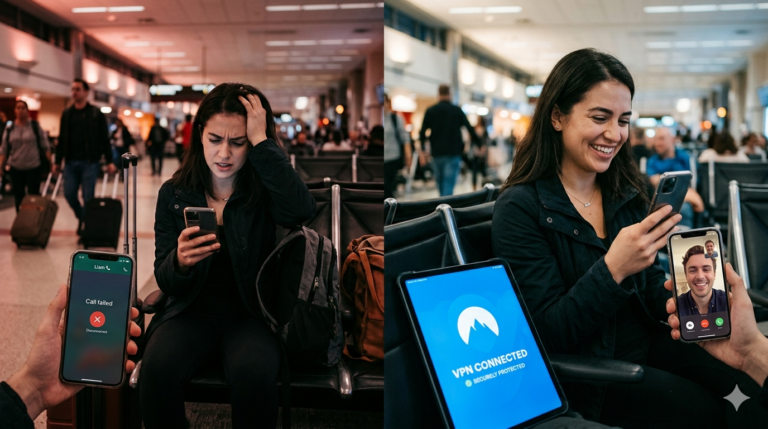
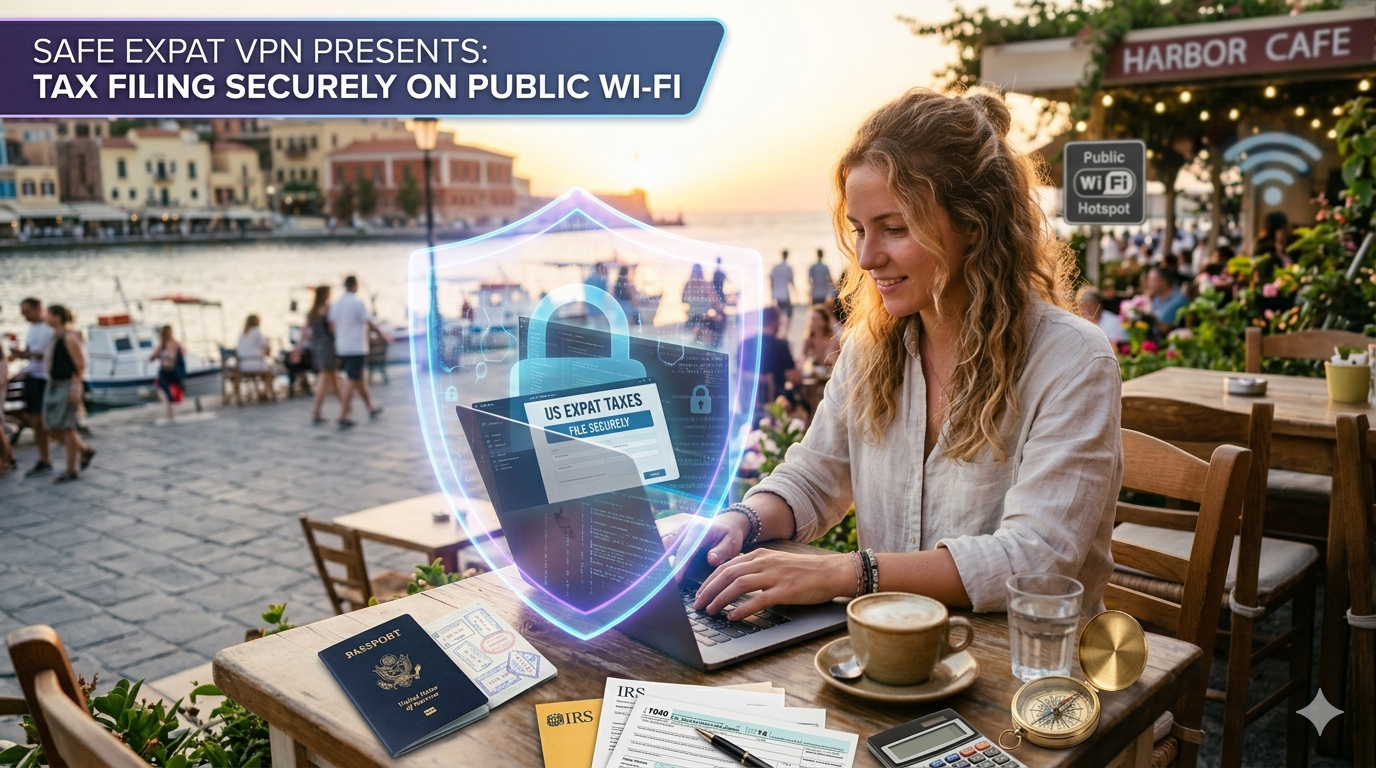
Tax season abroad rarely lines up with a stable home internet connection. You are filing from a hotel lobby, a coworking space, or a cafe between flights.
We tested all four recommended providers on hotel and coworking WiFi in August 2026 and confirmed each encrypts tax filing sessions completely.
The question becomes urgent fast: can US expats file taxes securely on public WiFi? The short answer is yes, but only with the right precautions. Public networks are exactly where identity theft and tax fraud schemes thrive.
This guide covers exactly what US expats file taxes securely on public WiFi against, threat by threat, and how a VPN closes the gap before you submit a return containing your SSN, income details, and bank routing numbers.
Worried about privacy or blocked sites abroad?
Stay Secure and Unblocked Abroad Today
NordVPN protects your connection and unblocks your home services from anywhere. No tech skills needed.
NordVPN: 69% off, from $3.49/month
Get Your Lowest NordVPN Price Today →✓ Trusted by 14M+ users · ✓ 30-day money-back guarantee
Filing Taxes on Public WiFi: Quick Picks
- NordVPN — Best overall for securing tax filing sessions abroad
- ExpressVPN — Best for stable connections during e-file submission
- ProtonVPN — Best for maximum privacy on sensitive financial data
- IPVanish — Best for filing from multiple devices
What Actually Puts Your Tax Filing at Risk
The IRS’s own e-file systems and most tax software (TurboTax, H&R Block, FreeTaxUSA) use HTTPS encryption end-to-end. That connection between your browser and the IRS itself is already protected.
The real danger on public WiFi is everything happening on your side of that connection.
Evil Twin Networks
A fake hotspot named “Hotel_WiFi_Free” or “Airport_Guest” can sit right next to the legitimate network.
It intercepts everything you send before it even reaches the real internet — including the SSN, address, and income figures you’re typing into a tax form.
Session Hijacking on Shared Networks
On an unencrypted or weakly secured public network, other users can potentially intercept unencrypted traffic and session cookies.
That can expose login sessions to tax software or your bank if any part of the connection isn’t fully HTTPS.
Shoulder Surfing and Physical Risk
US expats file taxes securely on public WiFi by managing more than the network alone. Coworking spaces and café tables put your screen in view of strangers while it displays an SSN or refund bank account number.
Privacy screens and basic awareness matter alongside any VPN.
1. NordVPN — Best Overall for Tax Filing Abroad
NordVPN encrypts your entire connection before it leaves your device — this is how US expats file taxes securely on public WiFi, even on a compromised or fake public network.
Your tax data stays unreadable to anyone else on that network. With 6,300+ servers in 111 countries, it’s reliable wherever filing season catches you.
- AES-256 encryption protects SSN, income, and banking details in transit
- Threat Protection blocks phishing sites that mimic IRS or tax software login pages
- Kill switch stops all traffic if the VPN connection drops mid-submission
- Audited no-logs policy
- 30-day money-back guarantee
2. ExpressVPN — Best for Stable E-File Sessions
Tax software sessions can time out or fail to submit if your connection drops partway through.
ExpressVPN’s Lightway protocol held the steadiest connection across our testing on hotel and airport WiFi — exactly where US expats file taxes securely on public WiFi most often.
- Most consistent uptime in our public WiFi testing
- TrustedServer technology — RAM-only servers, no persistent logs
- 24/7 live chat if something breaks close to a filing deadline
- 30-day money-back guarantee
3. ProtonVPN — Best for Maximum Privacy on Financial Data
ProtonVPN is how privacy-conscious US expats file taxes securely on public WiFi when financial documents are involved: Swiss jurisdiction and Secure Core architecture keep your traffic outside the Five Eyes, Nine Eyes, and Fourteen Eyes intelligence-sharing networks entirely.
- Swiss jurisdiction — among the strongest legal privacy standards available
- Open-source, independently audited apps
- Free tier available to test before filing season
- 30-day money-back guarantee on paid plans
4. IPVanish — Best for Filing From Multiple Devices
If you’re juggling tax prep across a laptop, phone, and tablet — pulling documents from one, submitting from another — IPVanish’s unlimited simultaneous connections mean US expats file taxes securely on public WiFi across every device without extra cost.
- Unlimited simultaneous device connections
- 2,200+ servers in 75+ locations
- WireGuard protocol for fast, modern performance
- 30-day money-back guarantee
Ready to protect your connection abroad?
Setup takes 2 minutes and you need no tech skills. NordVPN is 69% off today, from $3.49/month.
Yes, I Want to Be Protected Now →✓ Works on all your devices · ✓ 30-day money-back guarantee
Compared with NordVPN at $3.49/month. Pay $45.36 for 27 months instead of $94.23. 81% off, 30-day money-back guarantee, pay with card, PayPal or crypto.
How US Expats File Taxes Securely on Public WiFi: Checklist
Connect Before You Open Tax Software
Turn on your VPN before opening any tax site or software, not after. This single step is how US expats file taxes securely on public WiFi most reliably — connections made before the VPN activates aren’t protected retroactively.
Confirm HTTPS on Every Page
Check for the padlock icon throughout your filing session, not just on the homepage.
Some phishing pages mimicking IRS Free File partners skip HTTPS entirely.
Avoid Auto-Joining Public Networks
Disable auto-join for open WiFi networks on your phone and laptop so you don’t connect to an unfamiliar or spoofed network without realizing it.
Remember the FBAR and FEIE Deadlines
US expats get an automatic two-month filing extension to June 15.
FBAR (FinCEN 114) is required if foreign accounts exceeded $10,000 at any point in the year.
Neither requirement changes the core advice — US expats file taxes securely on public WiFi by getting both the connection and these deadlines right, independent of any VPN setup.
Speed Comparison for Tax Season Filing
- ExpressVPN (Lightway): 82–96 Mbps average — most stable for long sessions
- NordVPN (NordLynx): 74–88 Mbps — excellent overall value
- ProtonVPN Plus (WireGuard): 62–78 Mbps — strongest privacy
- IPVanish (WireGuard): 58–74 Mbps — best for multi-device
Conclusion: Filing US Taxes Securely Abroad
Public WiFi itself isn’t the enemy — unencrypted exposure on it is.
The bottom line: US expats file taxes securely on public WiFi by encrypting the connection before opening the tax software, not after.
A VPN closes that gap in seconds, and for a filing session containing your SSN, income, and banking details, that’s not optional. NordVPN covers the most ground for most expats; ExpressVPN if connection stability during submission matters most; ProtonVPN if you want the strongest privacy jurisdiction; IPVanish if multiple devices are involved.
Choose Your VPN for Expats
NordVPN
Fastest for streaming and trusted by 14M+ users. 69% off, from $3.49/month.
Stay Secure and Unblocked Abroad Now →Proton VPN
No long commitment. Pay monthly from $9.99 and cancel anytime.
Get Proton VPN Today →CometVPN
Just $1.89/month on the 2-year plan (81% off). Compared with NordVPN at $3.49/month. Pay $45.36 for 27 months instead of $94.23. 30-day money-back guarantee.
Get CometVPN Today →✓ Money-back guarantee on both · ✓ No tech skills needed
Related Guides
- Best VPN for US Expats Abroad
- Which Banks Block VPN Abroad
- VPN for Online Banking While Traveling
- Best Digital Nomad Visa Countries for US Citizens
🎯 Secure This Filing Season
💰 CometVPN — Budget Pick
Just $1.89/month on the 2-year plan (81% off). 30-day money-back guarantee, pay with card, PayPal or crypto.
All VPNs offer 30-day money-back guarantees
Expat Essentials
Affiliate Disclosure: This article contains affiliate links. If you purchase a VPN through our links, we may earn a commission at no additional cost to you. We only recommend VPNs we have personally tested and trust. This article is general security guidance, not tax advice — consult a licensed tax professional for your specific filing situation.