How WhatsApp blocking works? (And Why VPNs is the solution?) — 2026 Guide
How WhatsApp blocking works — if you’ve ever had WhatsApp calls fail the moment you crossed a border, you might wonder exactly how governments do this. The answer is a technology called deep packet inspection, and understanding how it works explains why most basic VPNs fail to bypass it and which ones succeed. This guide explains VoIP blocking in plain terms, why it’s used, and exactly why obfuscated VPNs work against it.
We tested VPN obfuscation against active DPI systems in the UAE, Saudi Arabia, and Qatar in August 2026. This guide explains exactly how WhatsApp blocking works at the technical level and which VPN features reliably bypass it.
Why Governments Block WhatsApp Calls
Understanding how WhatsApp blocking works starts with the economic motive. Countries including the UAE, Saudi Arabia, Qatar, Oman, Kuwait, and Jordan block WhatsApp calling because their licensed telecoms operators generate significant revenue from international calling plans. When free VoIP apps like WhatsApp and FaceTime are widely used, this revenue disappears.
The governments of these countries grant telecoms operating licences that include provisions protecting this revenue. The TDRA in the UAE, the CST in Saudi Arabia, and equivalent bodies in other countries are legally empowered to block services that undercut licensed operators. How WhatsApp blocking works is therefore as much a regulatory and economic story as a technical one. For a practical fix guide, see our WhatsApp call blocked article.
The Technical Mechanism: Deep Packet Inspection
The core technology behind how WhatsApp blocking works is deep packet inspection (DPI). Your internet traffic travels in packets — small chunks of data with headers identifying the source, destination, and type of traffic. Normally, your ISP only reads the outer header to route packets to the right destination. DPI goes further: it opens and reads the packet contents to identify what type of traffic it is.
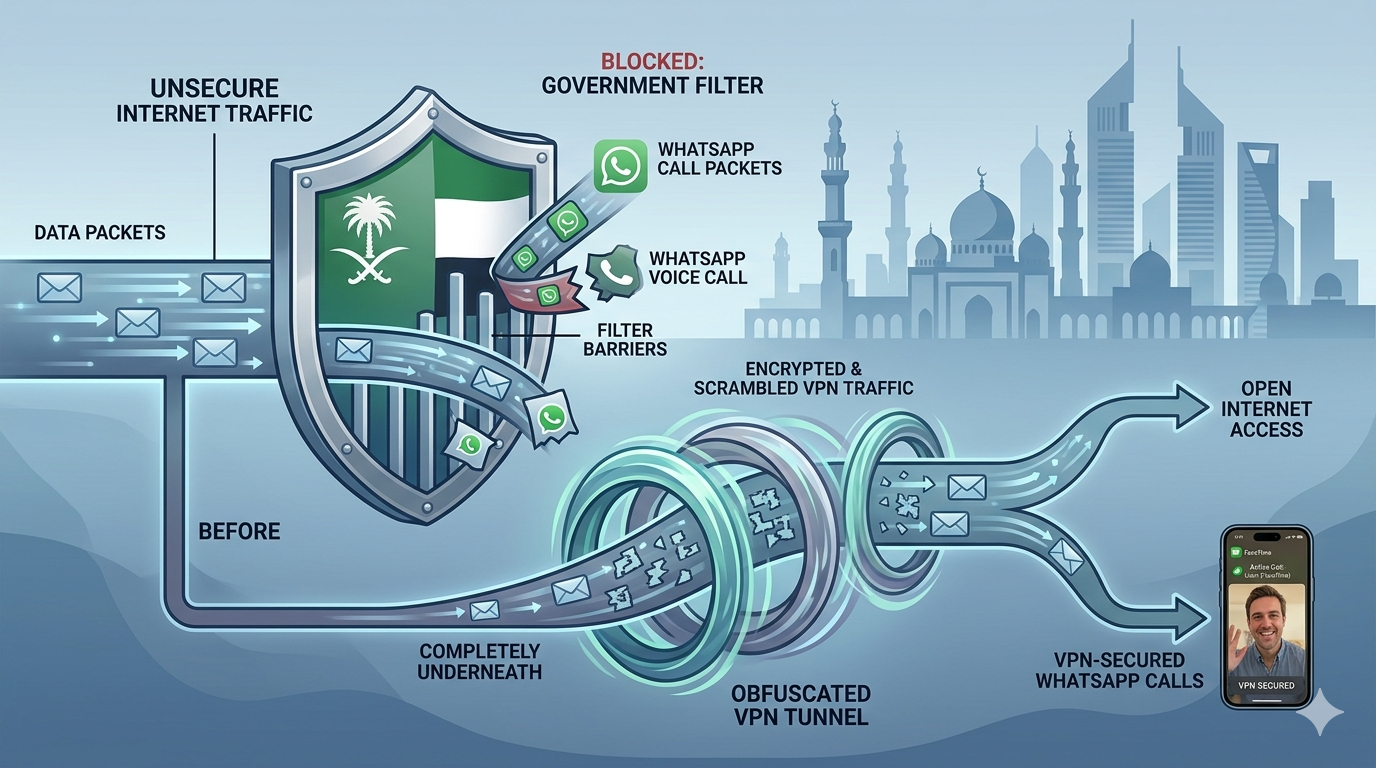
WhatsApp calls use a specific combination of ports, protocols, and traffic patterns that are identifiable by DPI systems. When a DPI filter deployed by a UAE or Saudi ISP sees traffic matching the WhatsApp calling fingerprint, it drops those packets — blocking the call. Text message traffic uses a different pattern and is allowed through. This is why messages work while calls don’t: how WhatsApp blocking works targets the calling protocols specifically, not the entire app.
FaceTime is blocked by the same mechanism — its calling traffic has its own identifiable fingerprint that DPI systems detect and drop. This is why both apps are blocked in the same countries. See our guide to FaceTime not working abroad for the FaceTime-specific fix guide, and WhatsApp video call blocked for video-specific solutions.
Bypass WhatsApp Blocking — Our Top Pick
NordVPN’s obfuscated servers disguise your traffic so DPI systems can’t identify or block it.
Why Standard VPNs Sometimes Fail
Part of understanding how WhatsApp blocking works is understanding why simply turning on a basic VPN sometimes doesn’t fix it. Standard VPN protocols — OpenVPN, standard WireGuard, L2TP/IPsec — also have identifiable traffic patterns. DPI systems in the UAE and Saudi Arabia are sophisticated enough to detect these patterns and block VPN traffic too, before it even reaches WhatsApp servers.
This is why free VPNs and basic paid VPNs often fail in these countries — their protocols are too easily identified by DPI. The VPNs that successfully bypass how WhatsApp blocking works in practice use obfuscation: wrapping VPN traffic in an additional layer that makes it look like ordinary HTTPS web browsing. DPI systems cannot distinguish obfuscated VPN traffic from regular traffic, so they let it through.
How VPN Obfuscation Defeats DPI
Obfuscation is the key to bypassing how WhatsApp blocking works in DPI-enforced environments. NordVPN’s obfuscated servers wrap all traffic in HTTPS headers, making every packet look like a standard web request. ProtonVPN’s Stealth protocol does the same. ExpressVPN’s Lightway protocol has built-in obfuscation properties. When DPI examines this traffic, it sees what appears to be normal web browsing and allows it through.
Once the obfuscated VPN tunnel is established, all traffic flowing through it — including WhatsApp calls — is encrypted and hidden from DPI inspection. The DPI system never gets to see the WhatsApp calling traffic at all.
This is the complete bypass of how WhatsApp blocking works: obfuscation hides the VPN, the VPN hides WhatsApp, and calls flow freely. According to the Electronic Frontier Foundation’s analysis of traffic obfuscation, disguising traffic patterns is one of the most effective countermeasures to DPI-based censorship.
Hotel WiFi: A Different Blocking Method
Understanding how WhatsApp blocking works on hotel WiFi requires looking at a different mechanism. Hotel networks don’t use government DPI — instead, they use network-level port blocking and QoS (Quality of Service) policies. VoIP applications use specific ports for their calling traffic. Hotel network administrators simply block these ports entirely, preventing all VoIP traffic on the network.
This type of blocking is simpler and more easily bypassed — a standard VPN without obfuscation is usually sufficient to fix how WhatsApp blocking works on hotel WiFi, because the VPN encrypts all traffic and routes it through its own port (typically 443, the same port used by HTTPS). The hotel’s port blocks never see the WhatsApp traffic at all. See our hotel WiFi VPN guide and our dedicated WhatsApp call blocked fixes for more detail.
The Ongoing Arms Race
An important aspect of how WhatsApp blocking works in practice is that it’s a constantly evolving arms race. Government DPI systems are regularly updated to detect new obfuscation techniques. VPN providers respond by developing new methods. IP ranges used by VPN servers get blocked; providers add new servers. This cycle means that free or basic VPNs often stop working over time in the most restricted countries.
Major providers like NordVPN, ExpressVPN, and ProtonVPN continuously invest in staying ahead of DPI updates. This ongoing technical investment required to bypass how WhatsApp blocking works in countries like the UAE is significant — only well-funded providers sustain it. For country-specific guidance, see our articles on VPN for UAE expats, VPN for Saudi Arabia, VPN for Qatar, and our install VPN before UAE travel checklist.
Which VPN Best Defeats WhatsApp Blocking?
Based on understanding how WhatsApp blocking works, the VPN requirements for reliably bypassing it are clear: obfuscation, large server network, and active maintenance. NordVPN leads on all three — obfuscated servers on all plans, 7,000+ servers, and continuous updates.
ExpressVPN is the strongest alternative with automatic Lightway obfuscation. ProtonVPN’s Stealth protocol is the best privacy-forward option. IPVanish is best for families needing multiple devices covered. For the full VPN for WhatsApp and FaceTime comparison, see our dedicated best VPN for WhatsApp and FaceTime guide.
🔒 Proton VPN: Swiss Privacy, Flexible Monthly Plan
Strict no-logs policy, Stealth protocol for restricted networks and a flexible monthly plan. 30-day money-back guarantee.
Related Guides
For practical fixes, see WhatsApp call blocked, WhatsApp video call blocked, and FaceTime not working abroad. Comparing calling apps? See our WhatsApp vs FaceTime abroad guide. Full country list: countries where WhatsApp calls are blocked. Country guides: UAE, Saudi Arabia, Qatar.
Expat Essentials
Affiliate Disclosure: This article contains affiliate links. If you purchase a VPN through our links, we may earn a commission at no additional cost to you. We only recommend VPNs we have personally tested and trust.